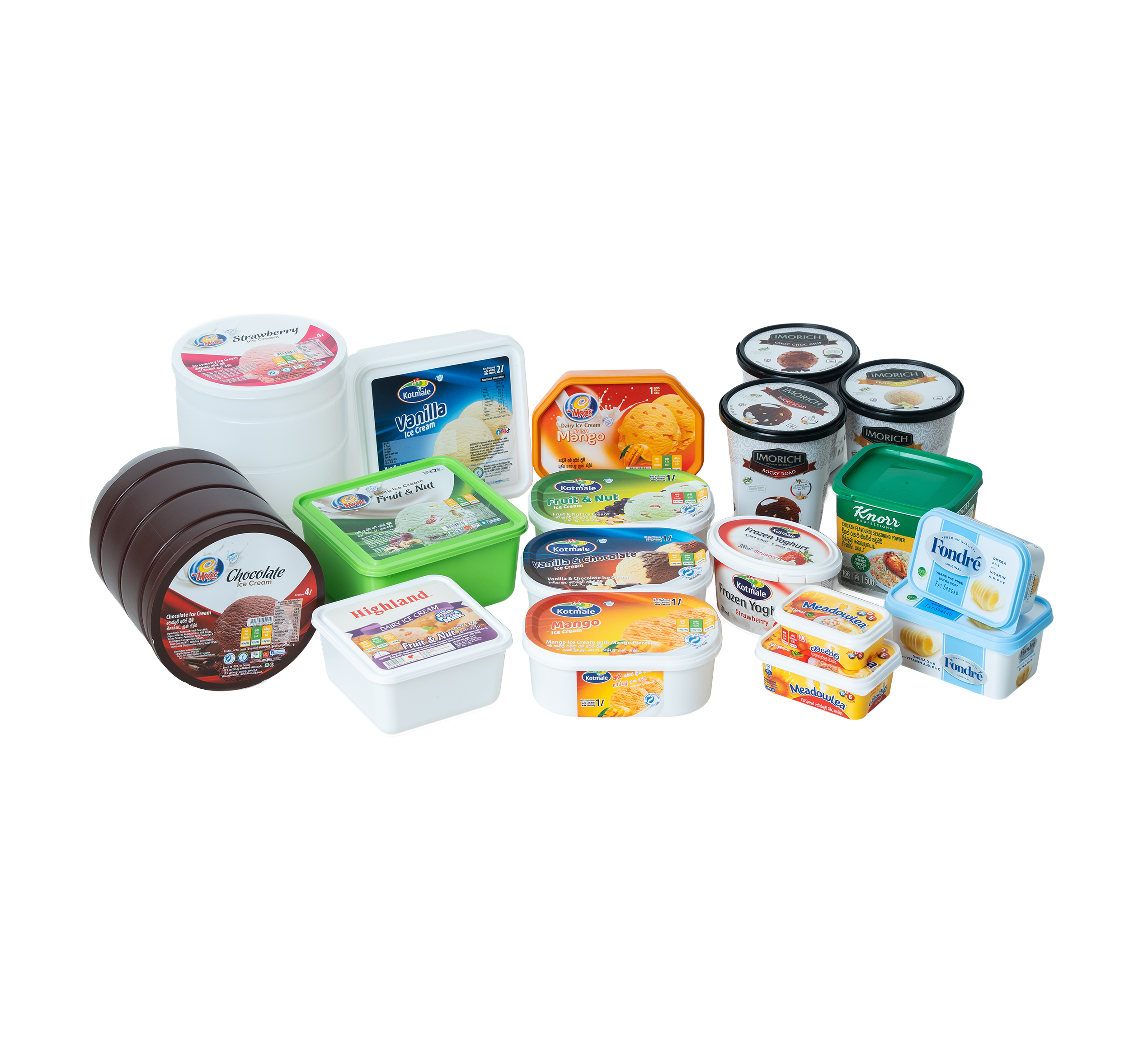
Choosing between in-mould labelling vs labels (stickers, screen printing, or sleeves) is one of the first decoration decisions a food or FMCG brand faces. Stickers are quick and cheap to start. Screen printing is simple and direct. Shrink sleeves wrap the whole pack. In-mould labelling (IML) builds the graphics into the container itself. Each method works, but each suits different volumes, products, and budgets.
IML is growing worldwide. Persistence Market Research projects the in-mould labels market will grow from US$3.1 billion in 2026 to US$4.5 billion by 2033, a 5.4% CAGR, and Packaging South Asia has reported growing adoption of IML tubs for ice cream and food in the region. At JPI, we introduced an automated IML production line in 2015 and began producing IML labels with advanced printing machines in 2025, so we run both the moulding and the labelling side of this process. This guide compares the options honestly, including when traditional labels are the better choice.
What is in-mould labelling (IML)?
In-mould labelling is a decoration method in which a pre-printed plastic label goes into the mould before the container forms, so the label and the container fuse into one piece. The label does not sit on the surface like a sticker. It becomes part of the container wall. You can read a general overview of the technique in this in-mould labelling reference.
How the IML process works
The process follows four steps:
- Print. The label, usually a plastic film such as polypropylene, is printed in full color and cut to shape.
- Place. A robot places the label into the open mould, where it is held in position.
- Mould. Molten plastic fills the mould, and heat and pressure bond the label to the container wall.
- Release. The finished container leaves the mould with the graphics already built in, ready for filling.
Because the label and container are made at the same time, IML removes a separate labelling step from your filling line. IML works mainly with injection-moulded tubs, pots, and lids, which is why IML containers suit ice cream, dairy, spreads, and similar food products. (In US spelling, the same process is called in-mold labeling.)
Traditional options: pressure-sensitive labels, screen printing and shrink sleeves
Traditional decoration methods apply graphics after the container is made. Three are common.
- Pressure-sensitive labels (stickers): A printed label with adhesive is applied to the finished pack. They are flexible, cheap to start, and easy to change, which suits small runs and frequent artwork updates.
- Screen printing: Ink prints directly on the container. It gives bold, durable graphics for logos and simple designs, though detailed or photographic images are harder to reproduce.
- Shrink sleeves: A printed plastic sleeve slides over the pack and shrinks tightly with heat. Sleeves give full 360-degree graphics and suit unusual shapes, but they add a separate material to the pack.
Side-by-side comparison: durability, look, hygiene, cost, recyclability
Use this table as a quick guide. Actual results depend on your container, product, and volume.
| Factor | IML | Pressure-sensitive labels | Screen printing | Shrink sleeve |
|---|---|---|---|---|
| Durability | Very high: label fused into the wall, resists scuffs and moisture | Moderate: edges can lift or peel in moisture or cold | High, though ink can wear on rubbing | Good, but sleeves can tear or shift |
| Look | Full-color, photographic quality, smooth and premium | Good, with a visible label edge | Best for simple, bold graphics | Full 360-degree coverage |
| Hygiene | No adhesive, no label edge to trap dirt, easy to wipe | Adhesive layer and edges can collect residue | Smooth surface, no extra layer | Sleeve edges and gaps can trap moisture |
| Setup cost | Higher: label printing and tooling for each design | Low | Low to moderate, depending on colors | Moderate |
| Cost at volume | Often lower per pack, since labelling is built into moulding | Higher per pack, as application is a separate step | Moderate | Moderate to higher |
| Flexibility for changes | Lower: a new design needs new labels | Highest | Moderate | Moderate |
| Recyclability | Supports mono-material, recycling-friendly design when label and container share a polymer family | Adhesive and label material can complicate recycling | Often simplest, since no extra material is added | Sleeve must be removed or can disrupt sorting |
On recyclability, treat every claim with care. IML supports mono-material, recycling-friendly design, but real recyclability depends on local collection and sorting systems, so check what your market accepts.
Where IML performs best: ice cream, dairy, spreads and freezer products
IML performs best on rigid food containers that face moisture, cold, handling, and long shelf life.
- Ice cream tubs: IML ice cream tubs are the best-known example. Freezer temperatures and condensation can make adhesive labels lift or wrinkle. A fused IML label stays flat and sharp, which is why this segment has driven much of IML’s growth.
- Dairy and yogurt pots: Fridge moisture and frequent handling suit a label that cannot peel.
- Spreads, margarine, and dips: Premium full-color graphics help these products stand out in busy chillers.
- Freezer and ready-meal containers: Durable graphics survive cold, moisture, and stacking.
IML also helps with shelf impact. The label wraps the container wall seamlessly, so the pack looks like it was designed as one piece. PlasticsToday’s coverage of IML with certified renewable polymers shows how the industry now links this decoration method with sustainability goals as well as appearance.
When traditional labels are the better choice
IML is not always the right answer. Traditional labels often win in four situations.
- Short runs: IML needs printed labels and setup for each design, so small quantities may cost more per pack than stickers.
- Many SKUs: If you sell dozens of flavors or variants in low volumes each, stickers and screen printing let you switch artwork easily.
- Frequent design changes: Seasonal packs, promotions, and regulatory updates are easier with labels you can reprint quickly.
- Container type: Some shapes and moulding processes suit sleeves or direct printing better than IML.
Many brands use both. They start with stickers to test the market, then move proven bestsellers to IML once volumes justify it. Our buyer’s guide to custom plastic packaging in Sri Lanka explains how decoration choices affect cost and MOQs more broadly.
What volume makes IML worthwhile?
No single quantity makes IML worthwhile for every brand, because the answer depends on how your costs spread. Ask for a comparison based on the total cost of a finished, decorated pack, not just the container price.
Four factors decide the break-even point:
- Volume per design: IML favors high, repeat volumes of the same design, since setup costs spread across more packs.
- Labor saved: IML removes the separate labelling step, which matters more as your output rises.
- Waste and rework: Labels that peel, wrinkle, or misalign cost money, and IML reduces these problems.
- Brand value: A premium look can support a higher shelf price, which changes the math.
Ask your supplier to quote the same container three ways: with stickers, with screen printing, and with IML. Compare the results at your real annual volume and your real number of SKUs. The pattern becomes clear quickly.
Designing artwork for IML
Good IML results start with good artwork. Plan for the process from the first draft.
- Start with the container size and shape. The label must fit the wall area, and curves, ribs, and corners affect how artwork sits.
- Supply print-ready artwork. Vector files with defined colors and bleed give the cleanest results.
- Allow for the process. Avoid fine detail across edges, corners, or ribs, where the label can stretch or shift.
- Plan barcodes and legal text. Keep them on flat, clear areas and test that they scan.
- Check food-contact suitability. Ask your supplier for compliance information on the label film and inks for your product and market.
- Test a sample. A feasibility check and a physical sample catch problems before full production.
Frequently asked questions
What is the difference between IML and normal labels?
IML fuses a printed label into the container during moulding, so the graphics become part of the wall. Normal labels are applied to the finished container afterward, usually with adhesive. IML resists peeling and moisture, while normal labels offer easier changes and lower startup cost.
Is IML more expensive than stickers?
IML has higher setup costs, but it can cost less per finished pack at higher volumes because labelling happens during moulding. Stickers cost less to start and suit small runs. Compare total finished-pack cost at your real volume.
What is the difference between IML vs shrink sleeve labelling?
It depends on the pack. IML gives a durable, smooth finish with no extra material, while shrink sleeves cover unusual shapes and give full 360-degree graphics. Sleeves add a separate material, which can complicate recycling.
Is IML recyclable?
IML supports mono-material, recycling-friendly design when the label and container share the same polymer family. Real recyclability still depends on local collection and sorting, so check what recyclers in your market accept.
Which products suit IML best?
IML suits rigid food containers that face cold, moisture, and handling, such as ice cream tubs, dairy pots, spreads, and freezer products. It also suits brands that want premium, full-color graphics on high-volume lines.
Can I use IML for small runs or many SKUs?
You can, but costs per pack may be higher than stickers or screen printing. Many brands test with labels first, then move bestselling products to IML once volumes justify the setup.
Request IML samples
Considering IML for your food or FMCG range? Request IML sample tubs and a free artwork feasibility check from our team. Tell us your container size, number of SKUs, and annual volume, and we will compare IML with your current labelling method. Contact our team to get started.